Introduction

A picture of the puppets being used in action

Teatr Grodzki, established in 1999, is a non-profit organization in the region of southern Poland with a complex and wide artistic and educational program to combat social exclusion. We offer arts workshops (theatre, puppetry, computer animation and fine arts) and training programs (drama education and social economy) for instructors, teachers, therapists, artists, volunteers and workers of non-governmental organizations, as well as vocational training programs for socially excluded groups.

Making paper puppets constitutes a part of our art workshops in theatre and puppetry, aimed at groups of people with learning difficulties and ones threatened with social exclusion. This can also be a part of vocational training, as making paper puppets equips beneficiaries with desirable manual skills, self-confidence, problem-coping techniques, etc., thus promoting their independence. The trainers may apply the app to achieve the above, but the app can also be used with various project partners (e.g. the MEDART project partners), as part of sharing good practices, for the partners to use the app in the remote training of their beneficiaries.

The target group:

  • trainees with various learning disabilities, 18+
  • can be adopted to any age group, including children and senior citizens

The trainee will be able to:

  • make a paper puppet (to be used as a theatrical prop, a toy, an adornment, etc.)
  • give own workshops in kindergartens, schools, etc.
  • increase his/her IT skills
  • gain self-reliance
  • become more autonomous

Task

An explanation of the puppet making task in more detail

What are they doing?

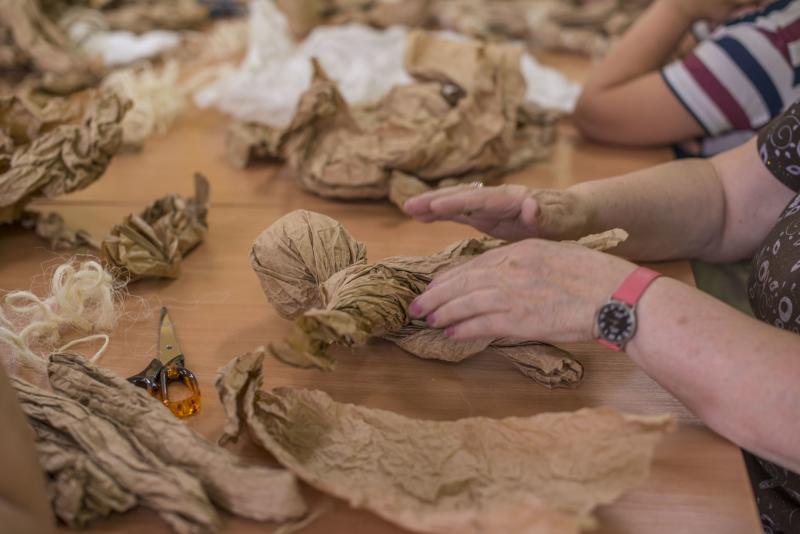
The trainees are in a group, seated at a big table situated in the middle of a room, making paper puppets using manila (wrapping) paper, hemp string and scissors.

Why are they doing it?

The paper puppets will serve as theatrical props in puppet theatre performances. However, they can also be used as toys, ornaments, gifts, etc.

What do you expect them to get out of it?

Making the paper puppets, trainees with various learning disabilities, 18+ (although the activity can also be adopted to fit any age group, including children and senior citizens) are going to achieve practice and expertise in making paper puppets/dolls. As a consequence, they will be able to make various kinds of paper puppets in a skilled manner, without an instructor’s assistance. This will empower them with greater self-confidence, autonomy and self-reliance, and as a consequence, they will be able to use the newly acquired skill in making own artefacts, giving own workshops in kindergartens, schools, etc. The added value of making paper puppets with the assistance of a simple training app will be the increase of the trainee’s IT skills, which will also make him/her more attractive for prospective employers.
Process

MAKING PAPER PUPPETS

https://www.youtube.com/watch?v=DJ5-Tsf65CA

Teaching our beneficiaries how to make simple paper puppets and props.

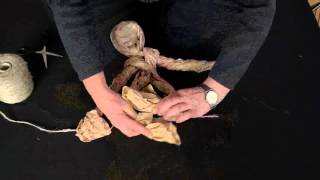
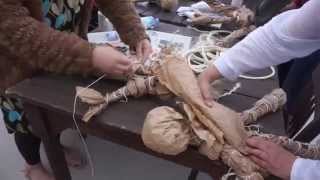
  1. We need a table, a few sheets of brown paper, scissors and some string (hemp string works very well).
  2. First, we need to make the paper more flexible and softer by crumpling and crushing it, so that it becomes similar to fabric – soft and flexible.
  3. Next, we tear it and form the shape of a head (a ball).
  4. We cover it with a wide paper sheet.
  5. We tie a string around the puppet’s “neck”.
  6. The rest of the paper below the neck should be twisted up into two arms. All parts must be tied up with string.
  7. The same must be done with two other long pieces of paper which will be used for torso.
  8. The paper sheet should be cut or torn in half.
  9. It should be twisted.
  10. One piece should be bent in half and wrapped around one of the puppet’s shoulders.
  11. Then, the procedure needs to be repeated and the two pieces should be joined and tied up with string at the top.
  12. The two pieces sticking down must then be joined together and tied up with string to form a circular shape.
  13. Two other long pieces of paper, which will be used for legs, should be twisted up.
  14. Just like the torso, the legs must be bent in half, twisted and wrapped around with string.
  15. Then, the torso should be covered with one wider sheet of paper.
  16. The sheet of paper should then be tied up with string.
  17. Thus, the basic structure of the puppet can be made.

Note:

· The trainees need to be pre-warned paper can cut your skin easily. Therefore, it is useful to wear thin protective gloves

· It may be difficult for the trainee to estimate how much paper/string is required to make a puppet, so the trainer should specify the amount depending on the desired puppet size. In general a big sheet of paper 1mx1,3m and 10 m of string should be sufficient to make one small puppet

· Various types of paper and string may be used. The ones that work the best are: manila (wrapping) paper and hemp string

Learning Objectives

Knowlege acquired

  • receive orders and plan own steps
  • describe the steps of making a puppet
  • explain to others how to make a puppet
  • name the different elements of a puppet
  • repeat the steps related to making a puppet

Skills acquired

  • receive orders and plan own steps
  • use information and communication
  • use certain IT devices (a smartphone; a tablet)
  • develop a plan of making a puppet
  • select appropriate materials for making a puppet
  • describe and discuss the procedure with the trainer/trainee

Competences acquired

  • calculate production
  • apply problem solving techniques
  • reflect upon his/her own action
  • cope with and withstand strain and stressful situations in a way that is not harmful to health
  • communicate with appreciation with patients, family members/reference person groups involved in the care process
  • answer questions related to the making of paper puppets
  • express and receive situation-based criticism

Conclusion

We are hoping that by following the steps described above and using the additional materials provided through links below you will be able to successfully teach your trainees how to make paper puppets to be used as props, toys, or otherwise, thus helping them get included in the job market, increasing their skills and self-confidence.