


Introduction
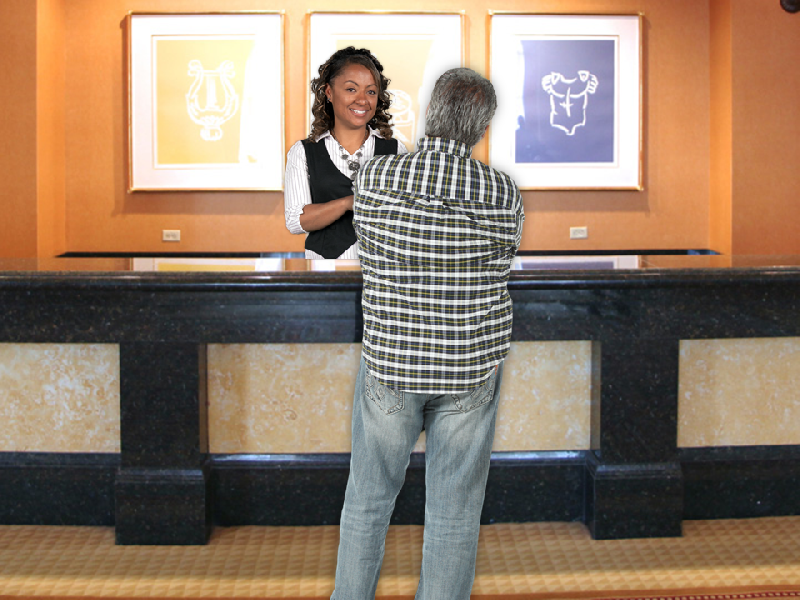
A picture that shows to smile when greeting a customer
Whether in a hotel, retail store or at the front desk of a company, greeting a visitor/customer is one of the most important topics. It can seriously damage sales, customer loyalty and therefore have a negative impact on the company. To ensure a long term relationship with the customers and subsequently for the benefit of the company it is necessary for the employees to have knowledge about
- how greeting affects the customers,
- how to act when greeting visitors/customers and
- what to say when greeting visitors/customers.
Therefore we developed an app on social competences with the name „How to greet visitors/customers“. The app is divided into two parts:
- How to Greet and
- “I CARE”.
The first part is an introduction about how greeting affects customers; the second part is the actual main part of the app and provides answers the questions „How to act when greeting visitors/customers?“ and „What to say when greeting visitors/customers?“
Task
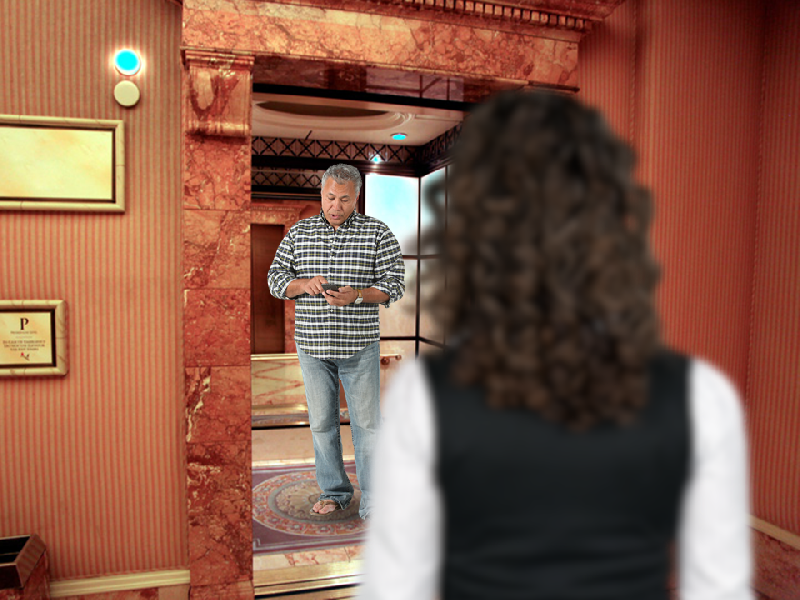
This picture shows a customer who enters the door
Companies as well as their employees have an interest to improve their communication skills and customer relations. No matter which business your trainees are in, greeting a customer is one of the most important topics. It can damage sales and have a negative impact on them and their company. That is why the task of training over and again in the act of greeting is very important for companies.
The app serves to look up information of how to greet visitors/customers. It is also ideal for the mediation of basic knowledge in the field of greeting.
Process
This app aims to aid with self-directed learning. Learners may pause, repeat and skip the lessons as they please, therefore setting their very own pace in terms of learning and processing the content.
Start of the app
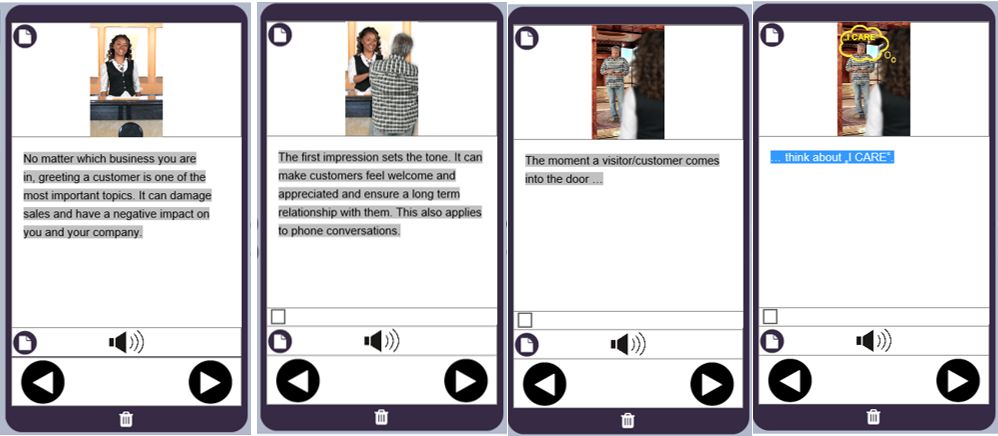
These are the start screens of the app. They consist of pictures with spoken words and subtitles. The subtitles will be sequentially faded in. The reason why the pictures with spoken words and subtitles were chosen is that they are simple and effective for people with disabilities.
The main content should be really simple and in pieces for people with disabilities that they can easily remember it. Therefore, the content is seperated in pieces through letters which should represent the “chapters”. Every letter (= ”chapter”) has it’s own colour which should make it easy for the participants to know immediately where they are in the app. That provides a quick and easy navigation around the app.
The "I CARE"
The “I CARE” is based on the “I CARE” method from Dick Marks. The letters with the content from Marks were completely modified and only in few points similar than in the video with the “I CARE” method from Marks.
The content of every letter (= ”chapter”) should be images with spoken words and subtitles. They should represent a realistic view. The pictures include demonstrations and are therefore very effective for people with disabilities.
I: Make your customers feel welcome. Give them your attention, make eye contact and smile. Use their name whenever appropriate. If you don’t know the customer‘s name, show them that you remember them. If you don’t regonize the customer, ask her/him if she/he has visited before.
C: You want to engage the customer in a conversation, don’t use „Can I help you?“. The answer is usually „No, just looking“. Start a natural conversation that is welcoming and relaxed. Talk about something inoffensive and something everyone can relate to, like for instance the weather. If there is anything interesting, unusual or new in your store/company, mention it. Try to use the customers‘ name as well as your own.
A: If you can't greet the customer right away, acknowledge him or her by making eye contact and smiling. If you‘re serving another customer, ask if she/he minds if you quickly greet the new arrival before you do so. Never assume that someone wants to be left alone. Always greet an arriving customer warmly, and in case of a cold response, tell her/him you will be nearby.
R: Remembering what a customer‘ likes and dislikes pays dividends. It makes customers feel like a regular and that you care. Personal attention is a great way to create customer loyalty.
E: Ask questions and show you care. Don‘t forget to get the right exit: The effect of a great greeting can easily be lost with a bad goodbye. Don’t just thank them, walk them to the door and open it for them.
